What happens to the dredged materials?

Find out about how we are using dredged materials from our £120 million Harwich harbour improvement project to secure the future of Mersea Island’s harbour…

  • Work begins to save Mersea Island harbour from erosion – BBC News
  • Harwich Harbour project to help recharge Mersea Island – Gazette
  • BBC Look East, 11 November 2021 –

Beneficial disposal project begins at Mersea Island


From around the 3 November 2021 the trailer suction hopper dredger Sospan Dau (IMO number: 7711062) will continue dredging in the main channel, but will move the disposal site from Horsey Island to the beneficial disposal scheme at Mersea Harbour.

The dredging contractor is the Boskalis Westminster / Van Oord Joint Venture appointed by the Harwich Haven Authority to carry out the Harwich Haven Channel Deepening Project.

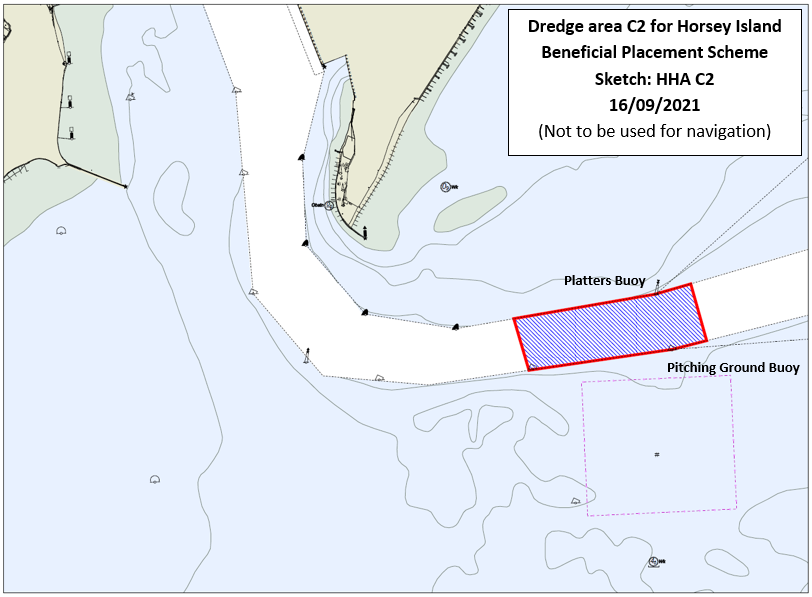
The dredge area is a section of the main channel known as area C2 covering the whole width of the main channel and running from about 250m east of the Platters / Pitching Ground buoys to about 1,000m west of the same buoys. (See attached sketch HHA C2 – available in the PDF version)

Dredged material will be disposed of to four separate sites in Mersea Harbour (at Cobmarsh Island, Old Hall Marsh, Tollesbury Wick and Packing Marsh Island). The aim of the scheme is to place sand and gravel into the four areas to reinforce the eroding foreshore and provide nesting areas for sea birds.

The dredger will sail between the dredge site and Mersea Harbour generally along the routes shown on the attached sketch map MH Routes 002. The route between the dredge area and point A on the sketch is defined by the following WGS84 waypoints:

WGS84 Latitude WGS84 Longitude
51° 55.60’N 1° 21.30’E
51° 53.85’N 1° 21.80’E
51° 52.73’N 1° 21.35’E
51° 48.79’N 1° 21.90’E

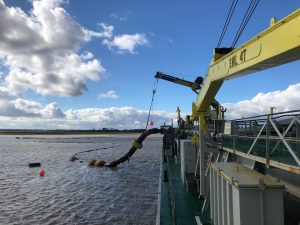
The dredger will dispose only at high water and be positioned as close to the disposal area as possible (see attached sketch MH 001 – available in the PDF version). Disposal will be carried out on every high water (weather permitting), day and night, either by direct pumping of material over the bow of the dredger, or via a floating pipeline. Connection of the dredger to the pipeline and positioning the placement end will be carried out by a Multicat MCS Anekke (IMO number: 9570905) and a small workboat, Taska 1. The floating pipeline will be held in place with anchors and marked with yellow can buoys fitted with flashing yellow lights.

The current programme is to commence disposal work at Tollesbury Wick and Packing Marsh Island, on or about 2 November 2021. It is hoped to finish the work at these sites and begin the placement at Cob Marsh.

On or around 16 November 2021 the operations will cease and the pipeline and the ancillary plant will be removed as the dredger has to leave the site and complete work on another project.

It is hoped that operations will begin again around 10 January 2022 (this will be confirmed by another Notice to Mariners), to complete the placement at Cobmarsh Island and at Old Hall Marsh. This second phase of the work should be completed around 4 March 2022. When completed, all plant and equipment will be removed.

It should be noted that some mooring and navigation buoys may need to be removed in order to complete these works. Further information and updates on buoy moves can be obtained from  Mersea Harbour Protection Trust at [email protected].

Mariners are requested to keep clear of the equipment and the site of the placement works.

The dredging is covered by the MMO licence held by Harwich Haven Authority: L/2020/00360/2.

The disposal of material at Mersea Harbour is covered by MMO licence held by the Mersea Harbour Protection Trust: L/2018/00131/3.

A memorable evening at the Tendring Youth Awards 2021

Harwich Haven Authority were the headline sponsor at this year’s Tendring Youth Awards, in partnership with Essex County Council and Tendring District Council.

On Tuesday 19 October Harwich Haven Authority’s CEO, Neil Glendinning attended a glittering presentation evening at the Princes Theatre, Clacton, to celebrate young people from Harwich and Dovercourt who demonstrate determination and passion for their community. Guests included the Lord Lieutenant of Essex, Mrs Jennifer Tolhurst.

“I always look forward to attending the Tendring Youth Awards presentation evening,” says Neil Glendinning. “The passion, enthusiasm and professionalism of everyone involved in the organisation of the event is highly commendable.

“The achievements of the young people nominated was even more remarkable because many of them have their own challenges to deal with. Listening to their stories was both humbling and inspirational. We often hear about the bad things young people become involved with, but I’m happy to report that young people living in Tendring are working really hard to make the world a better place.”

The comprehensive evening programme also provided young performers the opportunity to showcase their talents in dance, singing and acting.

In addition to sponsoring the overall event, Harwich Haven Authority championed two specific awards categories – Community Improvement and Unsung Hero. The latter category was won by local Dovercourt hero Jay Barham who runs a sweet treats outlet near Earlham’s Beach. His business is very much a social enterprise and he has raised thousands of pounds for both local and national charities. In addition, Jay also supports teenagers with complex needs by offering them opportunities to learn new skills and gain formal qualifications within his business.

The full list of winners can be found here.


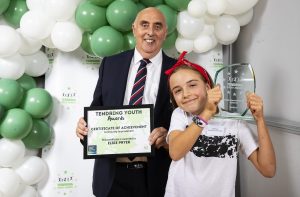
Left: Community Improvement Award winner, Elsie Pryer (age 9) put her running shoes on during lockdown to raise money for a bridge building project in Ghana. Elsie was also presented with a cheque for £250 to support her fundraising activities.
Right: Harwich Haven Authority’s CEO, Neil Glendinning with Unsung Hero, Jay Barham. 

It’s start day for our channel deepening project

Beautiful day in the Haven to start our £120 million channel deepening project with our joint venture contractors Boskalis and Van Oord.

Work will start on the first of two planned beneficial placement projects using materials from the dredge to support a RSPB habitat initiative on Horsey Island, Essex. Read more.

Read our latest Notice to Mariners.

  
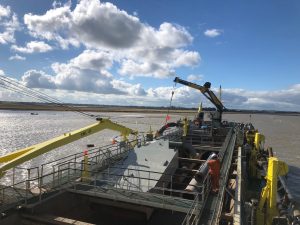
Pictured – trailer suction hopper dredger Sospan Dau in the Walton backwaters.

How will the channel be deepened?

The harbour and channel will be deepened mainly using trailer hopper suction dredgers (TSHD) which suck material from the sea bed as they move slowly through the water.

TSHDs are self-contained dredging units which pump sediments from the sea bed via a suction pipe or pipes (2), into an inboard hopper. Whilst slowly moving forward, the vessel loads, with the suction head (1) of the pipe suspended at a predetermined level. As the dredged material settles within the hopper (3), excess water (taken on board during suction activity) is overflowed from the hopper. When the hopper reaches capacity, the dredger proceeds to the disposal ground where the dredge
material is released through bottom  doors.

It is likely that a small amount of hard dredging will be done with a backhoe dredger – a large excavator on a pontoon, loading into barges, for disposal at sea.

The works will be regularly surveyed to ensure no over-dredging occurs and that all disposals are placed within the licensed site.

Wildlife in the Haven

A number of fish species are present in the dredge area, including prey species for birds and marine mammals and commercially important species such as sole, bass, skates and rays. There are a number of herring spawning grounds within the wider Outer Thames Estuary area. The Stour and Orwell estuaries offer nursery grounds for species such as sand smelt and bass.

Changes in suspended sediment concentration within the water column during the deepening works are predicted to be within the range of natural variation. As such, these changes are not anticipated have a significant impact on fish species present within the general area. Likewise, any underwater noise generated by the dredging and disposal works is expected to be of low magnitude and would only have a negligible to minor impact on fish. Given benthic ecology is not considered to be significantly affected by the deepening, a significant loss of fish prey species is also not expected.


Benthic life

The subtidal and intertidal habitats within the Stour and Orwell estuaries are dominated by worms and bivalve molluscs, including protected species such as the native oyster. Diversity within the harbour and the approach channel is low and the species present at the disposal site are tolerant to disturbance due to ongoing maintenance dredging and disposal activities.

As a result of this, the deepening works and the subsequent maintenance dredging are considered to have a negligible to minor effect on benthic habitats and species. Additionally, there is expected to be no significant impact on water quality, since the sediment has been tested for contaminating chemicals and concentrations of such are below critical threshold values that could cause harm. This reduces the risk of indirect effects on marine species outside of the immediate dredge and disposal footprint.

The potential spread of Invasive Non-Native Species (INNS) will be controlled by following best-practice guidelines and international conventions. The footprint of the dredge area is no different from the area that undergoes regular maintenance dredging, so there is no new source of sediment that could result in the spread of INNS. As such, the risk of INNS being introduced or spread is negligible.

Marine Mammals

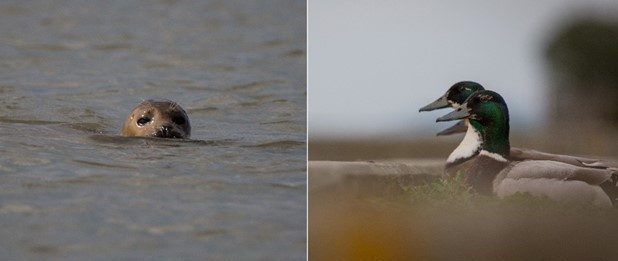
Marine mammal species present within the Stour and Orwell estuaries, and the wider coastal area, include harbour porpoise and both grey and harbour seals. Potential impacts to these species during the dredging and disposal works, through underwater noise from dredge vessels, risk of collision with vessels and loss of prey species, are predicted to be of minor to negligible significance.

In the longer term, any impacts that could potentially arise would be associated with future dredging activities aimed at maintaining the channel at the new depth. However, the significance of these impacts would be less than those associated with the initial deepening work as the intensity of the work will be lower.


Birds

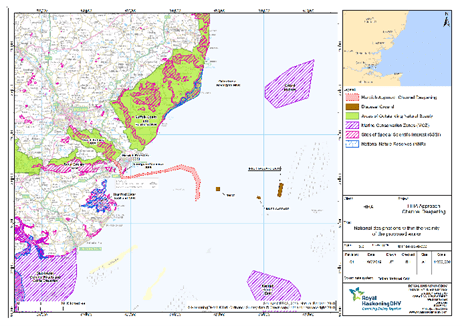
There are several important areas within the Stour and Orwell estuaries and surrounding environs for feeding, breeding and roosting waterbirds. There are a number of nature conservation areas within the estuaries and the wider Outer Thames Estuary area which are designated to protect these species. However, given the high level of human activity that occurs regularly within the estuaries and approach channel, no impact is predicted to birds during the dredging and disposal work.

The predicted change in the tidal range after the channel is deepened represents a very small reduction in intertidal area. This may cause some local re-distribution of feeding birds but, given that there are extensive areas of foraging habitats within the estuaries, this is not expected to have a significant or widespread impact. Given that benthic ecology and fish are not anticipated to be significantly affected by the deepening, a significant loss of bird prey species is not expected.


What will be the effect on local fishing?

Commercial and recreational fishing vessels operate within the general vicinity of the approach channel and disposal site all year round. Information from the Marine Management Organisation and consultation responses from local stakeholders have been used to characterise fishing activities and assess potential impacts on local fishing.

It is expected that the impacts on local commercial and recreational fishing vessels are expected to be negligible to minor, since the increase in vessel traffic during the deepening works is not predicted to be significant and the intensity of fishing within the approach channel and disposal site is relatively low. Impacts on the fish stocks would be negligible to minor too, as there is unlikely to be any significant disturbance or effects on water quality, fish prey species and seabed habitats.